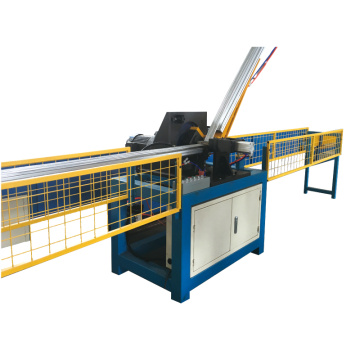
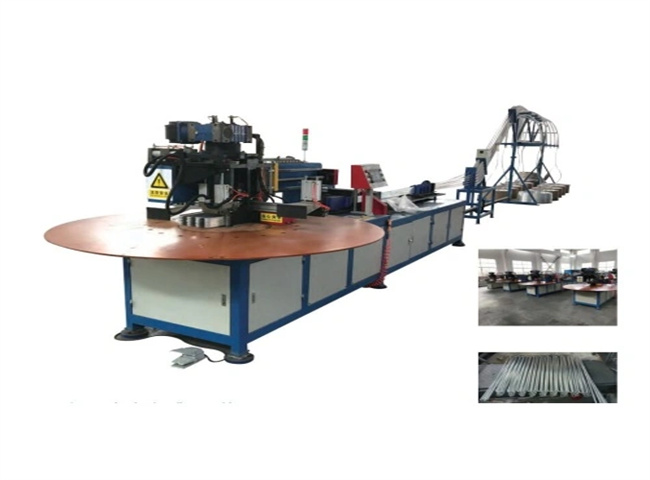
Equipment For In-line Type Evaporator refers to specialized manufacturing systems designed for continuous production of evaporator cores used in refrigeration and air-conditioning systems. These integrated production lines automate the entire manufacturing process, ensuring high precision and efficiency in creating heat exchange components critical for cooling equipment performance.
Working Principle
The in-line production process starts with material feeding, where aluminum or copper tubes and fins are supplied continuously. Automated machinery then assembles fins onto tubes through expansion or bonding, followed by bending, cutting, and forming operations to shape the evaporator core. Welding or brazing stations join components securely, while leak detection systems inspect for faults. The continuous flow ensures each production stage connects seamlessly, minimizing downtime between processes.
Structure and Components
Key components include automatic feeding systems, fin punching machines, tube expanding equipment, bending robots, welding/brazing stations, leak testers, and conveyor systems. Feeding systems ensure steady material supply, while fin punches create precise fin patterns. Tube expanders enhance fin-tube contact for better heat transfer. Bending robots shape cores into required configurations, and welding stations form airtight joints. Leak testers use pressure or vacuum methods to detect defects, with conveyors moving products through each stage.
Advantages
Continuous in-line production significantly increases output compared to batch processes, boosting efficiency by 30-50%. Automated operations ensure consistent component quality and dimensional accuracy, reducing performance variations in final evaporators. Integrated quality checks minimize defective products, lowering material waste. Labor costs are reduced through automation, while standardized processes simplify maintenance and training requirements.
Applications
These systems are essential in manufacturing evaporators for household refrigerators, air conditioners, and commercial cooling units. They produce evaporator cores for automotive air conditioning systems and industrial refrigeration equipment. Specialized versions cater to low-temperature evaporators for freezers and cryogenic applications, as well as compact evaporators for medical refrigeration devices.
Development Trend
Modern in-line evaporator equipment integrates IoT and data analytics for real-time production monitoring. AI-powered vision systems enhance quality inspection accuracy. Energy-efficient motors and heat recovery systems reduce environmental impact. Flexible designs allow quick reconfiguration for different evaporator sizes and types. Predictive maintenance features minimize downtime, while improved human-machine interfaces simplify operation and troubleshooting, aligning with smart manufacturing trends.