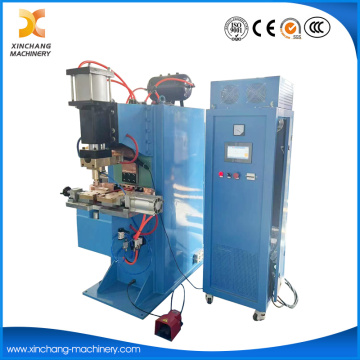
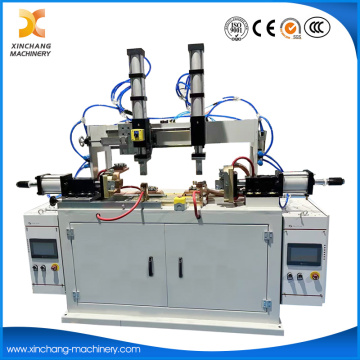
Introduction to the Fully Automatic Brake Shoe Seam Welding Machine
In the highly demanding and precision-driven automotive component manufacturing industry, efficiency, consistency, and quality are non-negotiable. The braking system, being paramount to vehicle safety, requires components manufactured to the strictest standards. Central to this system is the brake shoe, a critical part where structural integrity is vital. Introducing the Fully Automatic Brake Shoe Seam Welding Machine – a state-of-the-art robotic welding solution engineered specifically for the high-volume, high-quality production of automotive brake shoes through the roller seam welding process. This machine represents a significant leap in manufacturing technology, integrating advanced automation, intelligent control, and energy-efficient operation to redefine production benchmarks.
Core Function and Automated Workflow
This machine is designed for one primary, precise function: performing continuous, leak-tight seam welds along the longitudinal joint of a brake shoe’s backing plate and its friction material rim (or the joining of two metal sections of the shoe). What sets it apart is its complete, closed-loop automation, which eliminates manual intervention from loading to unloading.
Automatic Loading: The process begins at an integrated loading station. Brake shoe components, either fed by a conveyor belt from a previous operation or presented in a magazine, are precisely picked and positioned by a robotic arm or a dedicated servo-driven mechanism. The system ensures each component is correctly oriented and clamped into the welding fixture with zero misalignment, a crucial step for weld consistency.
Automatic Welding: Once secured, the machine's core takes over. The workpiece is rotated under the pressure of precision-ground copper alloy welding wheels (rollers). A sophisticated three-phase frequency conversion welding power supply activates, delivering a controlled, continuous stream of electrical current through the rollers at the seam interface. The rotation speed, pressure, and current are perfectly synchronized, creating a uniform, forge-weld along the entire circumference. This process is far superior to intermittent spot welding, resulting in a seam that is stronger, smoother, and more durable.
Automatic Unloading: Upon completion of the weld cycle, the clamps release. Another automated arm or ejector mechanism smoothly removes the finished brake shoe and places it onto an output conveyor or into a collection bin. The system then immediately cycles back to load the next component, maintaining a continuous, uninterrupted production flow.
Technological Advantages and Key Benefits
The design philosophy of this Automatic Brake Shoe Seam Welding Machine revolves around delivering tangible operational advantages:
High Degree of Automation & Labor Savings: This is the most transformative benefit. By automating the entire material handling and welding process, the machine dramatically reduces dependency on skilled welders. One operator can potentially oversee multiple machines, primarily performing monitoring and routine maintenance tasks. This leads to a substantial reduction in direct labor costs, mitigates risks associated with manual welding, and eliminates variability caused by human fatigue or inconsistency.
Superior Welding Quality & Consistency: Automation ensures every single brake shoe is welded under identical, pre-programmed parameters. The seam welding process itself produces a continuous, homogeneous bond with excellent structural integrity and often superior aesthetics compared to other methods. The automated control guarantees there are no weak spots, skips, or burn-throughs, leading to a consistently high-quality product that enhances the reliability and safety of the final brake assembly.
Advanced Three-Phase Frequency Conversion Welding Power Supply: This is the heart of the machine's efficiency and performance.
Energy Efficient & Cost-Effective: Unlike traditional single-phase welding transformers, the three-phase input balances the load on the power grid. The frequency conversion technology allows for precise control of the output current waveform, minimizing energy waste as heat and optimizing power consumption for the specific welding task. This translates to significant energy savings, reducing the factory's operational carbon footprint and electricity costs.
Stable Output & Durable: The power supply provides an exceptionally stable and controllable current, which is essential for creating perfect seam welds on materials like steel used in brake shoes. This stability, combined with robust construction, leads to fewer power-related faults and a longer, more reliable service life for the entire welding system, maximizing uptime and return on investment.
Robust Construction & Durability: Built for the harsh environment of a manufacturing plant, the machine features a rigid, vibration-resistant frame, high-precision guides for the welding head, and durable copper alloy welding wheels. It is designed to operate reliably over multiple shifts, day after day, with minimal downtime, ensuring a steady and predictable output.
Conclusion: The Future of Brake Shoe Manufacturing
The Fully Automatic Brake Shoe Seam Welding Machine is more than just a piece of factory equipment; it is a comprehensive productivity solution. It seamlessly addresses the core challenges of modern manufacturing: the need for higher output, impeccable quality, reduced operational costs, and better resource utilization.
By combining fully automated loading, welding, and unloading with an intelligent control system and a high-efficiency three-phase frequency conversion power supply, this machine delivers unparalleled consistency, superior weld integrity, and remarkable savings in both labor and energy. It empowers automotive parts manufacturers to enhance their competitiveness, meet stringent quality standards with ease, and embrace the future of smart, sustainable, and cost-effective production. For any operation focused on the manufacturing of critical safety components like brake shoes, this machine represents the pinnacle of welding technology and automated industrial excellence.


| Advantage: | Machine body of thick steel sheet, not easy to deformation |
| Microcomputer control, accuracy and steady | |
| Water cooling transformer: Use silicon sheets of 15000 gauss permeability to pile up. There is cooling water in inside, using full copper alloy core, reducing impedance, improving the utilization of power, 20% duty cycle to ensure the requirement of long time welding, big output power. The useful lifetime is longer, noise is smaller, structure is more compact and reasonable. | |
| Fast solenoid valve, making welding speed faster, thereby the productivity is higher, therefore decreasing cost. | |
| Cylinder adopt high accurate, anti-friction hard material, which is duralumin, without rust, lower friction, lower noise and loading is faster, thereby reducing the weld spatter. | |
| Quality is stable, failure rate is low, therefore machine life is longer |
| Model | BP-250 | BP-400 |
| Rated power | 250KVA | 400KVA |
| Input voltage | 3PH-380V,50HZ or customized | 3PH-380V,50HZ or customized |
| Cooling water flow | 50L/Min | 80L/Min |
| Cooling water temperature | 5~10ºC | 5~10ºC |
| Welding current | 32KA | 58KA |
| Compressed air | >=0.5MPa | >=0.7MPa |
| Number of welding point | 1~15 pcs | 1~15 pcs |
| Steel panel thickness | <=2.5mm | <=3.5mm |
| Welding motor power | 2.2KW | 2.2KW |
| Loading motor power | 0.75/0.4KW | 0.75/0.4KW |
| Duty cycle | 50% | 50% |
| Input cables | 50mm2 | 70mm2 |
| Welding cylinder max pressure | 7800N | 12000N |
| Machine weight | 2800kg | 3000kg |
| Overall size | 2600*1850*2500mm | 2600*1850*2500mm |
| Package size | 2700*1950*2550mm | 2700*1950*2550mm |
| Storage Nos of hopper | 150~200 pcs | 150~200 pcs |